
Glass Railings in Alameda, CA
Frameless tempered and laminated glass railings that protect the view while meeting California code.
The clearest way to keep your view
When the whole reason you are on the deck is the Bay, the skyline, or the hills, a glass railing is the most transparent guard you can build. Panels of tempered or laminated glass give you a full, uninterrupted sightline while still stopping wind, keeping kids and pets safe, and meeting code. At Alameda Custom Railing we design and install frameless and semi-frameless glass systems that look effortless and are engineered to carry real loads. Glass is the premium tier of railing, and it shows. Call (510) 390-9618 for a free on-site estimate.
What it is and who it's for
Glass railings are a type of guardrail that uses tempered or laminated glass panels for an unobstructed view.
A glass railing fills the guard with structural glass panels instead of balusters or cable. It is for homeowners who want the most open, contemporary look possible: view decks, rooftop terraces, balconies, pool surrounds, and modern interior stair landings. It is the natural fit for waterfront Alameda homes and hillside Oakland and Berkeley properties where the view is the whole point, and it also acts as a wind screen on exposed decks, letting you use the space on breezy Bay afternoons. Glass reads as clean and minimal, and it pairs well with both modern and transitional architecture.
Because glass is heavy and must be handled and anchored precisely, it rewards professional fabrication and installation. The mounting method and the glass spec are what make it safe.
Glass types and mounting systems
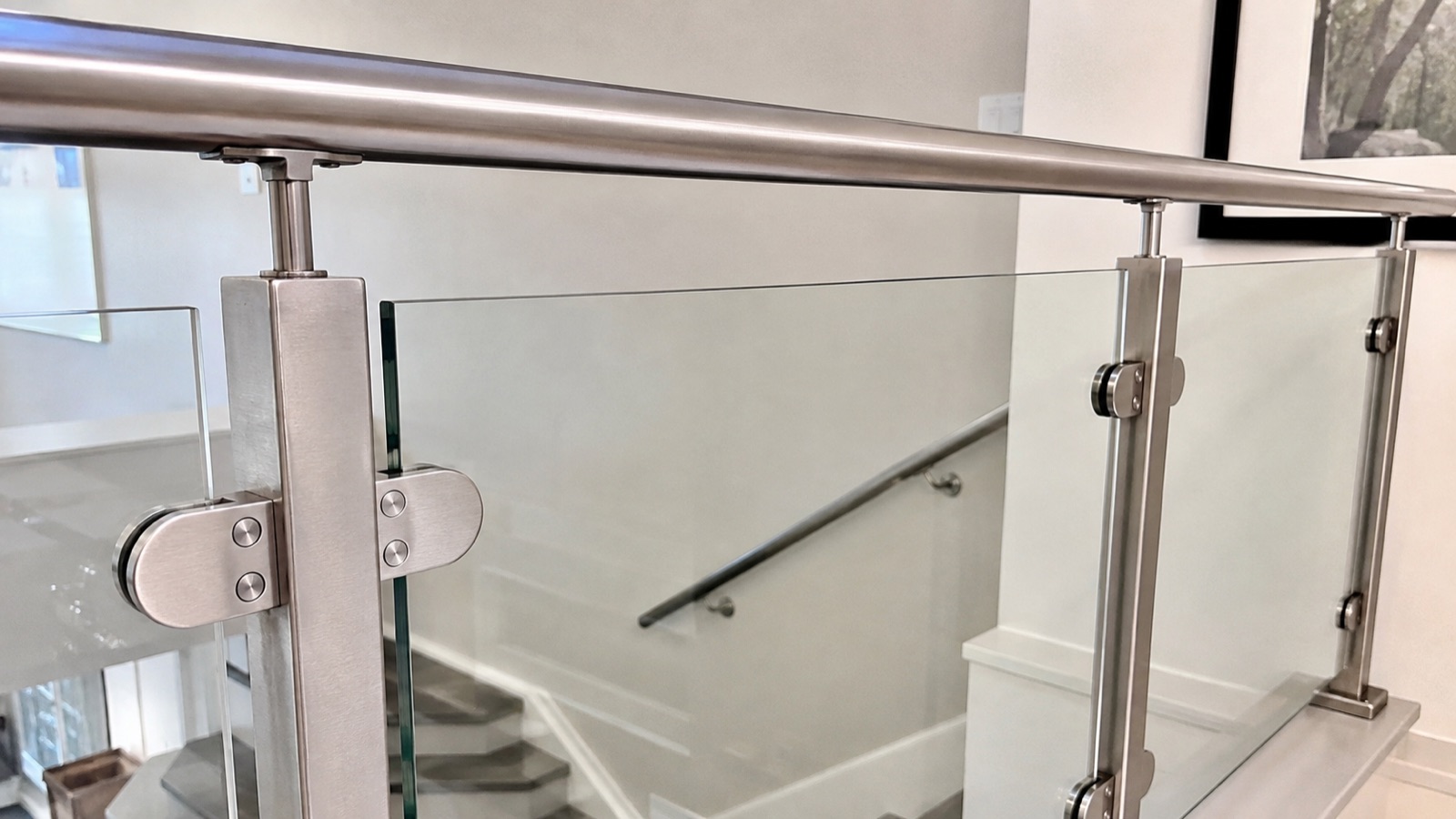
We work in tempered glass and laminated glass, and often laminated-tempered for guards where a broken panel must still stay in place. Typical thicknesses run from 1/2 inch to 3/4 inch depending on span and mounting. The mounting method sets the look:
- Standoffs: polished stainless or aluminum disc mounts that fix the glass to the deck edge or fascia for a floating, mostly frameless appearance.
- Spigots: discreet base clamps, usually 316 stainless, that grip the bottom of each panel for a clean, minimal frameless look.
- Base shoe: a continuous aluminum channel along the floor that grips the full bottom edge, giving a truly frameless top with strong structural capacity.
We can leave the top edge open and frameless or add a slim stainless or aluminum cap rail, which some inspectors prefer and many homeowners like for comfort. We help you choose based on your view, budget, and code path.
Code compliance
A guard is required where the walking surface is more than 30 inches above grade, and guards are typically 42 inches tall across East Bay departments. Glass used in a guard must be safety glazing, tempered or laminated, and the assembly must resist 20 pounds per linear foot at the top rail plus concentrated loads without the panel or its mounts failing. Any gaps at the base or between panels must respect the 4-inch sphere rule. Where a handrail is required it sits 34 to 38 inches high and must be graspable. Some jurisdictions require a top cap or a specific laminated build-up for a frameless glass guard. These rules come from the California Building Code and California Residential Code; always confirm the current glazing and guard requirements with your local building department.
How we build your railing
Consult & Measure
We review the view, the deck edge, and the mounting surface, and measure at no cost.
CAD & Shop Drawings
We detail panel sizes, mounts, and the glass build-up for your span.
Engineering & Code Review
We confirm glazing type, loads, and anchorage against local code.
Fabricate & Order Glass
We fabricate the mounts and order tempered or laminated panels cut to size.
Install & Set Glass
We anchor the standoffs, spigots, or base shoe and set each panel true.
Inspect
We verify spacing, plumb, and load, then pass final inspection.
Built for the East Bay
Glass itself does not corrode, but everything holding it up does, and that is the East Bay challenge. On Alameda's near-sea-level island, we specify 316 stainless standoffs and spigots and marine-grade or powder-coated aluminum base shoe so the hardware survives the salt air that would pit lesser metal. On the water and in the hills, wind load matters: a full-height glass panel catches the breeze, so we size the glass and mounts for real Bay gusts. For hillside Oakland and Berkeley homes along the Hayward Fault, we anchor the base shoe and standoffs into sound structure and detail the connections for seismic movement. And because glass shows every drop near the shore, we will talk you through easy cleaning and the low-iron options that stay clearer.
Honest pricing
Glass is the premium tier of railing, typically running $150 to $600 per linear foot installed. The spread is wide because glass type, thickness, panel size, and mounting method all move the number, and frameless base-shoe systems with large low-iron panels sit at the top. Corners and turns add roughly 20 to 30 percent, stairs cost more, permits run $50 to $500, and Bay Area labor plus marine-grade hardware push toward the high end. These are honest ranges, not a quote. Because glass pricing is so spec-dependent, the only accurate number comes from a free on-site estimate.
| Scope | Typical installed range |
|---|---|
| Standoff or spigot systems | $150–$400 / linear ft |
| Frameless base shoe / low-iron | up to ~$600 / linear ft |
Available across the East Bay
We install glass railings throughout Alameda County, including Alameda, Oakland, Berkeley, San Leandro, Hayward, and Castro Valley. From Bay-view terraces in Alameda to hillside decks in the Berkeley Hills, we match the glass and hardware to your view and your permit office.
Related services
Still deciding? Compare our cable railings for an open view at a lower price point, our deck and balcony railings for the full range of guard styles, or our aluminum railings when you want a low-maintenance framed option.
Questions, Answered
Is tempered or laminated glass better for a railing?
Both are safety glazing. Tempered glass is very strong and breaks into small pieces, while laminated glass holds together on an interlayer if it breaks. For guards where a broken panel must remain in place, we often use laminated-tempered glass. The right choice depends on your mounting system and local code, which we confirm before ordering.
What does frameless glass railing actually mean?
Frameless means there is no top or vertical framing, so the glass is held only at the base by standoffs, spigots, or a base shoe channel. It gives the most open, minimal look. We can add a slim cap rail if you prefer, and some inspectors require one, but a true frameless system leaves the top edge open.
Will the hardware rust near the Bay?
Not if it is specified correctly. We use 316 stainless standoffs and spigots and marine-grade or powder-coated aluminum base shoe on coastal Alameda and shoreline projects, so the metal that holds the glass survives the salt air. The glass itself does not corrode.
How hard is glass railing to keep clean?
It shows fingerprints and salt spray more than other railings, but cleaning is simple with glass cleaner and a squeegee. Low-iron glass stays clearer and greener-free for view decks. On exposed shoreline decks, expect to wipe it down more often, which is the trade-off for the clearest possible view.
Why is glass railing more expensive?
Glass is heavy, must be fabricated to exact sizes, and requires precise, strong anchoring, so both material and labor cost more. Installed pricing typically runs $150 to $600 per linear foot depending on glass type and mounting. It is the premium tier, and we give an honest quote after a free on-site estimate.
Ready to get started?
Alameda Custom Railing provides fast, same-day custom railing across Alameda, CA and the surrounding area — flat-rate pricing, licensed and insured, with 24/7 emergency service. Call now, request a free estimate or head back to our homepage.