
California Railing Code: Guard Height, the 4-Inch Rule & Handrail Rules
The code numbers you need, in one place
California railing requirements come from the California Building Code (CBC) and California Residential Code (CRC), and while the rulebooks are long, the numbers that decide most residential projects are few. This guide lays out the ones that matter — when a guard is required, how tall it must be, the 4-inch sphere rule, and handrail heights and grip — in plain language. These are the standards East Bay departments enforce, but codes are amended and interpreted locally, so always confirm specifics with your city before you build. For a railing designed and built to code from the start, call (510) 390-9618.
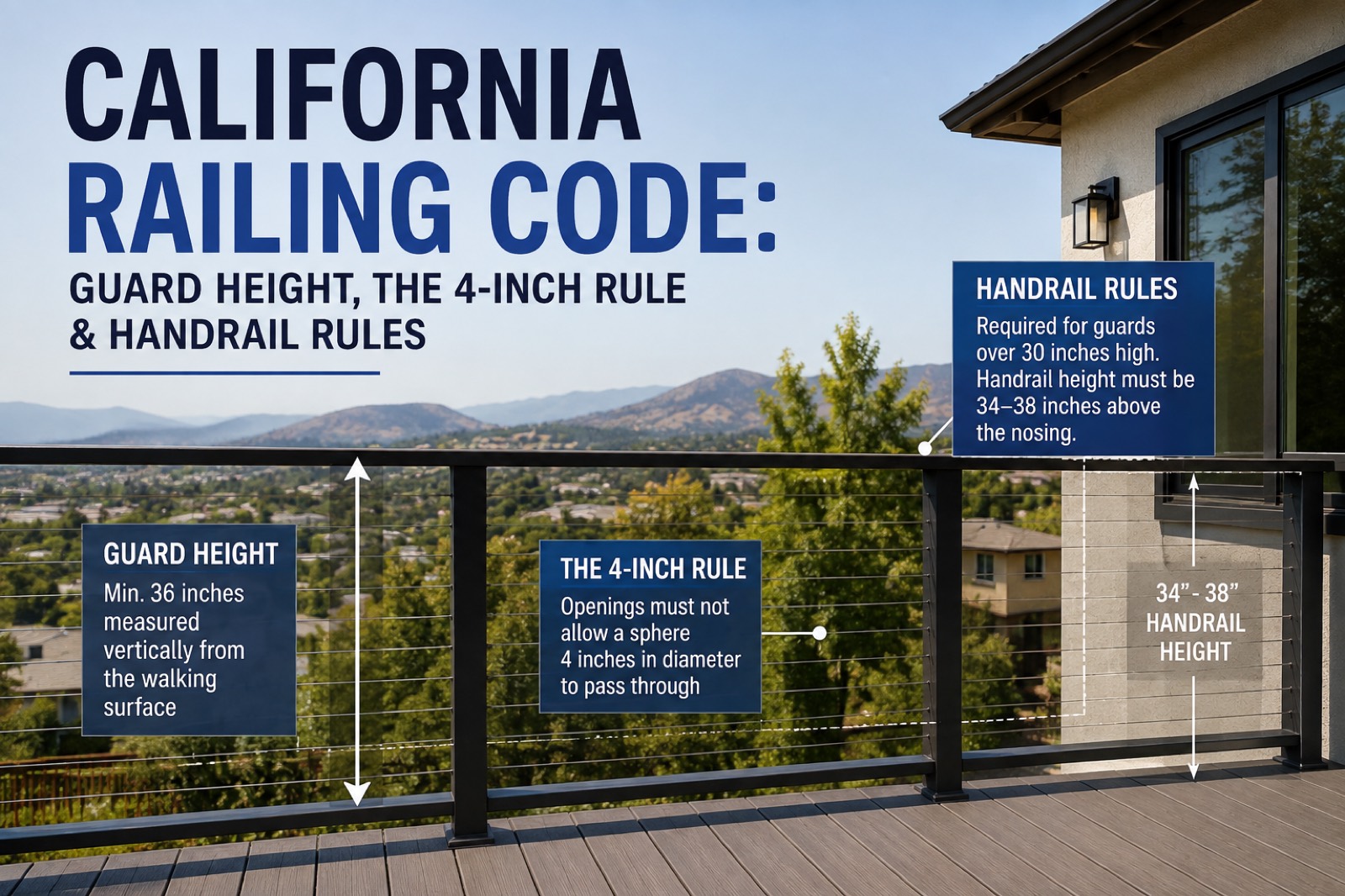
Key code numbers at a glance
| Requirement | Standard |
|---|---|
| Guard required when surface is above | 30 inches above grade/floor below |
| Guard height | 42 inches (enforced across East Bay) |
| Opening / baluster gap | Must not pass a 4-inch sphere |
| Stair-tread triangle opening | Must not pass a 6-inch sphere |
| Handrail height | 34–38 inches from stair nosing |
| Graspable handrail (Type I) | Circular 1¼″–2″ outside diameter |
| Handrail wall clearance | 1½ inches |
| Commercial handrail extensions | ≥12 inches past the top riser |
| Guard load (top rail) | Resist 20 lb per linear foot |
| Handrail load | 200-lb concentrated force |
Planning a concrete project in Alameda or the East Bay? Get a free, no-obligation on-site estimate and a written flat-rate price.
When you need a guard, and how tall
A guard is the barrier that keeps people from falling off an elevated surface. Code requires one wherever a walking surface — deck, balcony, landing, or open stair side — is more than 30 inches above the grade or floor below. That is the single most important trigger to remember. When a guard is required, its height must be 42 inches, measured from the walking surface to the top of the rail. East Bay departments in Alameda, Oakland, and Berkeley all enforce the 42-inch guard, and a guard that measures short is a common inspection failure.
The 4-inch sphere rule
The rule people mean when they say “the 4-inch rule” is about openings, not height. No gap in a guard — between balusters, under the bottom rail, between cables — may be large enough to pass a 4-inch sphere. The number comes from child safety: a 4-inch limit keeps a small child from slipping through or getting a head trapped. There is one relaxation: at the triangular opening formed by a stair tread, riser, and bottom rail, the limit opens to a 6-inch sphere. For cable railings this drives design — cables are spaced around 3 inches and kept tight, on posts about 4 feet apart, so deflection never lets the gap exceed 4 inches. See our cable railing page.
Handrail height and grip
A handrail is the graspable rail you hold going up and down stairs — different from a guard, though a single rail sometimes serves both roles. Handrail height is 34 to 38 inches, measured vertically from the stair nosing, and the handrail must be continuous along the flight and graspable. A Type I graspable profile is circular with a 1¼″ to 2″ outside diameter; ADA handrails follow the same 34–38″ range with 1½″ clearance to the wall. In commercial settings, handrails must extend at least 12 inches past the top riser so users have support through the transition. See our ADA and commercial handrails page.
Structural loads
Code is not only about geometry — railings have to be strong. A guard’s top rail must resist 20 pounds per linear foot, and a handrail must withstand a 200-pound concentrated load at any point. This is why anchoring matters as much as the rail itself: a beautiful guard bolted into rotten framing fails the load test even if every measurement is perfect. Proper posts, fasteners, and connection to sound structure are what make the numbers real.
A handful of details trip people up. Height is measured from the walking surface, not from the top of a curb or a wide cap rail, so a guard that looks tall enough can still measure short at inspection. On stairs, handrail height is taken vertically from the tread nosing — the leading edge of each step — not from the middle of the tread. The 4-inch sphere applies to every opening, including the frequently forgotten gap under the bottom rail. And “graspable” has a real definition: a wide, flat 2×6 laid on edge is not a graspable handrail, because your hand cannot wrap it. These are exactly the small misses that turn into a failed inspection and a return trip.
It also helps to keep the two components straight in your head, because people use “railing” for both. The guard is the fall-protection barrier — the 42-inch requirement, the 4-inch openings, the 20-pound top-rail load all belong to it. The handrail is the graspable assist on a stair — the 34-to-38-inch height, the 1¼-to-2-inch circular profile, the 200-pound point load belong to it. On many stairs a single assembly does both jobs at once, which is fine as long as each set of numbers is satisfied.
Confirm locally, then build it right
These are the core CBC and CRC standards, but your city can amend or interpret them, and historic homes — like Alameda’s under Historical Building Code 8-504 — can follow a different path. Always verify with your local building department, or let us do it. We design every railing to current code and coordinate with East Bay permit desks so your project passes inspection the first time.
Want a railing built to code without the guesswork? We handle the numbers and the permit. Call (510) 390-9618 for a free estimate.
Questions, Answered
How tall does a railing have to be in California?
Guards must be 42 inches tall, required wherever a walking surface is more than 30 inches above the grade below. Handrails on stairs sit at 34–38 inches from the nosing. East Bay departments enforce these; confirm locally.
What is the 4-inch rule?
No opening in a guard may pass a 4-inch sphere, which keeps small children from slipping through. The limit opens to 6 inches at the triangular opening at a stair tread.
What is the difference between a guard and a handrail?
A guard is the 42-inch barrier that prevents falls from an elevated surface; a handrail is the 34–38-inch graspable rail you hold on stairs. One rail can sometimes serve both, but the requirements differ. Call (510) 390-9618 with questions.


Need Help in Alameda?
Alameda Custom Railing provides fast, same-day custom railing across Alameda, CA and the surrounding area — flat-rate pricing, licensed and insured, with 24/7 emergency service. Landed on this article from a search? Head back to our homepage to see everything we do, or reach out now.