
SB 721 Balcony Inspection: What East Bay Property Owners Must Know (2026)
Why this matters right now
If you own a rental building with three or more units in the East Bay, California’s SB 721 — the “Balcony Bill” — already applies to you, and the first inspection deadline of January 1, 2026 has now passed. Buildings that missed it are out of compliance. The law was written after fatal balcony collapses, and it targets exactly the elements a railing shop works on: guardrails, handrails, decks, balconies, landings, stairways, and walkways. This guide explains what SB 721 requires, how it differs from SB 326 for HOAs, and what happens when an inspection turns up a failed guardrail. If your building needs guardrail or handrail repair to comply, call (510) 390-9618.
What SB 721 actually requires
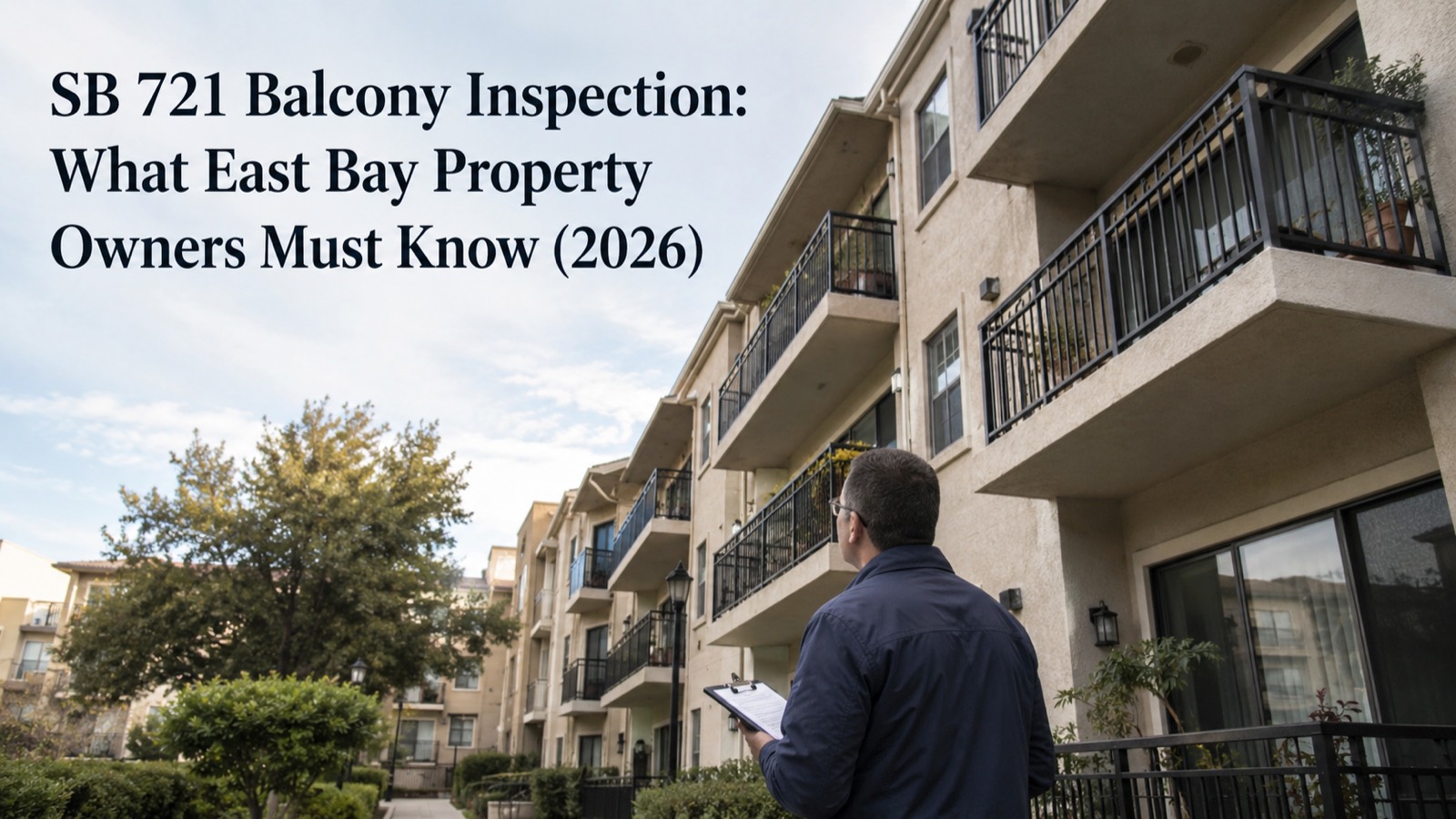
SB 721 applies to rental buildings with 3 or more dwelling units. It covers exterior elevated elements made of wood or steel framing — decks, balconies, landings, stairways, walkways, and their guardrails and handrails — where the walking surface is more than 6 feet above grade. A licensed professional must inspect at least 15% of each type of these elements. The first inspection was due January 1, 2026, and the cycle repeats every 6 years. The inspector documents current condition, identifies anything that threatens the safety of occupants, and flags what needs repair. The 15% sampling is per element type, so guardrails, handrails, decks, and stairways are each looked at as their own category rather than lumped together, and a problem found in the sample often points to the same issue across the rest of the building.
Planning a concrete project in Alameda or the East Bay? Get a free, no-obligation on-site estimate and a written flat-rate price.
SB 721 vs SB 326 vs San Francisco
| Law | Applies to | Cycle | Notes |
|---|---|---|---|
| SB 721 | Rentals, 3+ units | Every 6 years | First deadline Jan 1, 2026 (passed); ≥15% of each element type |
| SB 326 | HOA / condo associations | Every 9 years | The condo equivalent of SB 721 |
| SF Section 604 | San Francisco buildings | Local schedule | City adds its own requirements on top of state law |
The key split: SB 721 covers apartment-style rentals on a 6-year cycle, while SB 326 covers homeowner and condo associations on a 9-year cycle. San Francisco layers its own Section 604 requirements on top. If your property is in the East Bay, SB 721 or SB 326 is almost certainly your framework.
What it means for guardrails and handrails
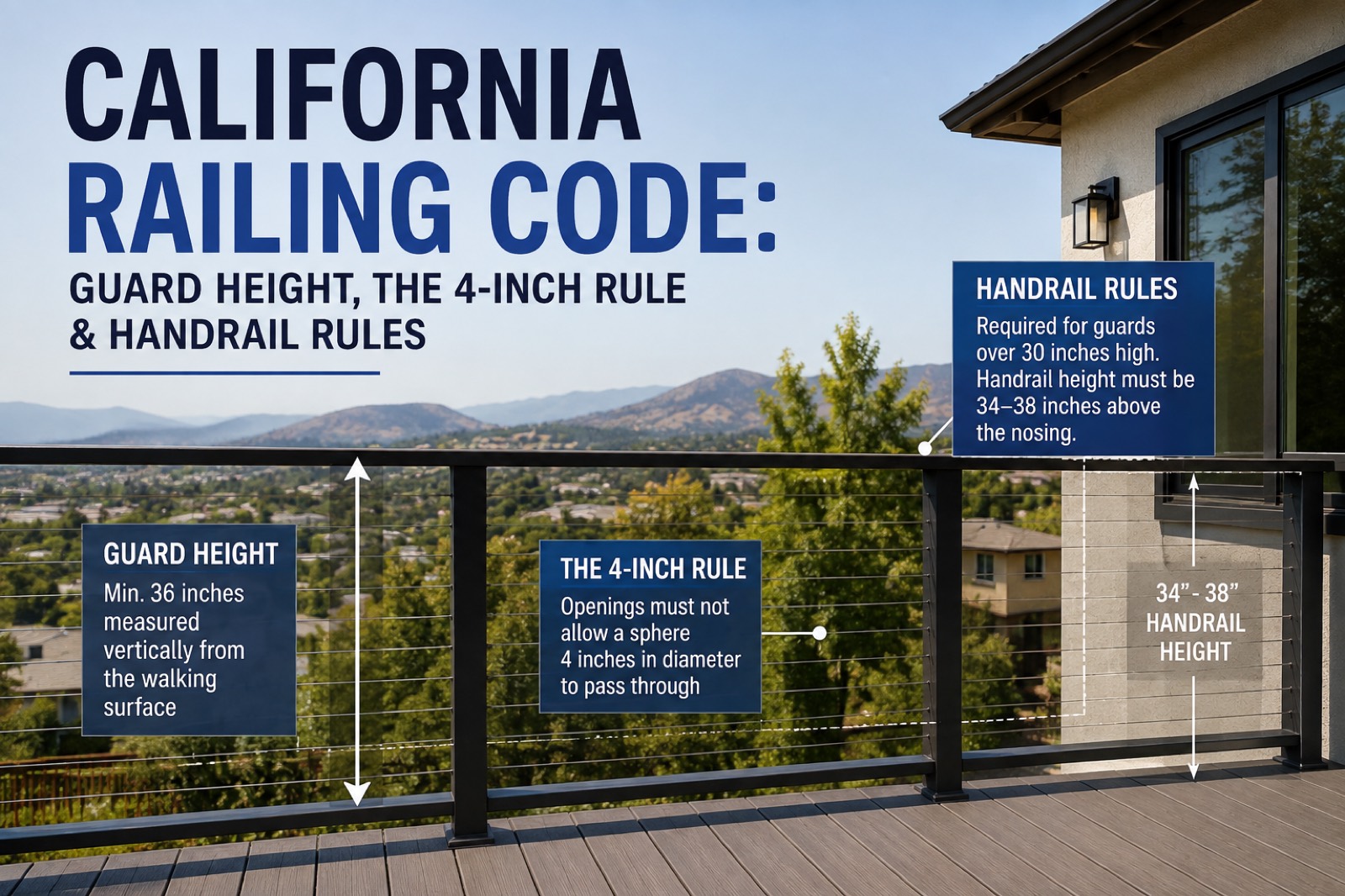
Guardrails and handrails are explicitly named in the law, and they are also among the most common things an inspector flags. On an aging wood-framed balcony, the guard posts are anchored into framing that may have taken on water for years. Inspectors look at whether the guard is solid, whether it meets height and spacing, and whether the connection to the structure is sound. A guard that wobbles, has corroded fasteners, or sits below the 42-inch code height is a failing condition — and because the guard is a life-safety element, it gets priority.
What happens if you fail
A failed inspection typically means the identified elements must be repaired, reinforced, or replaced, often within a defined window, by a licensed contractor. For guardrails and handrails that can mean re-anchoring loose posts into sound framing, replacing corroded steel, bringing a short guard up to the 42-inch standard, or fabricating and installing a new code-compliant guard where the old one is beyond saving. The work usually needs a permit, and the repair should be documented for your records and the next inspection cycle. This is squarely what our railing repair and SB 721 service handles.
One point that surprises owners: the guardrail and the structure behind it are one system. An inspector may fail a guard not because the rail itself is bad but because the wood framing it anchors into has taken on water and softened. In that case the fix is not just a new rail — it is repairing or replacing the compromised blocking and rim joist first, then anchoring a new guard into sound material so it can actually resist its 20-pound-per-foot load. Pricing a guard replacement without opening up that connection is guesswork, which is why we look before we quote.
A practical compliance path
If you own affected rental property in Hayward, Oakland, Alameda, or elsewhere in the East Bay, the sensible order is: get the required inspection by a licensed pro, get a scope and quote for any flagged guardrail and handrail repairs, complete the work under permit, and keep the documentation. Acting now — rather than after a code-enforcement notice or, worse, an incident — protects your tenants and your liability. We fabricate and install code-compliant guardrails and handrails and handle the repair side of SB 721 work throughout the East Bay.
This exposure is heaviest in the East Bay’s dense multifamily stock. A building owner in Hayward’s older downtown, an Oakland fourplex with wood balconies, or an Alameda apartment near the water all fall squarely inside SB 721, and their elevated wood-framed balconies are exactly the elements the law was written about. If you own several buildings, budget the inspection-and-repair cycle as a recurring six-year cost rather than a one-time surprise — it is far cheaper to plan for than to scramble after a notice. Keep every inspection report and repair permit on file; the next cycle, and any future buyer’s due diligence, will ask for them.
Failed a balcony inspection, or need guardrails brought up to code? We repair and replace SB 721 guardrails and handrails across the East Bay. Call (510) 390-9618.
If your building is a condo or HOA instead of an apartment rental, read the companion guide on SB 326 balcony inspections for East Bay HOAs and condos.
Questions, Answered
Does SB 721 apply to my building?
SB 721 applies to rental buildings with 3 or more units, covering wood- or steel-framed decks, balconies, stairways, and their guardrails and handrails more than 6 feet above grade. Condo and HOA buildings fall under SB 326 instead, on a 9-year cycle.
The January 2026 deadline passed — what now?
Get your inspection completed as soon as possible and address any flagged repairs. The requirement did not go away; buildings that missed the first deadline are out of compliance until inspected and any hazards are corrected. Call (510) 390-9618 for guardrail repairs.
Do you do the inspection?
The inspection itself is performed by a licensed inspector. We handle the repair and replacement side — re-anchoring, reinforcing, and fabricating code-compliant guardrails and handrails that failed. See our railing repair page.
Need Help in Alameda?
Alameda Custom Railing provides fast, same-day custom railing across Alameda, CA and the surrounding area — flat-rate pricing, licensed and insured, with 24/7 emergency service. Landed on this article from a search? Head back to our homepage to see everything we do, or reach out now.